Training Resources

Havening Techniques® Training with Carol Robertson: Havening Enthusiasts Group
I engage most days in this group, which has a Messenger and Facebook group. Here is how I have described the aims of this group. Access is by invitation.
Welcome to the Havening Enthusiasts Group on Facebook
This space allows us to put on our Havening Enthusiasts hats and cheer each other along by focusing on the material we are studying, sharing what is working for us and learning together. This platform enables us to store materials organised by topic categories. And then we can search and find the material we have shared.
I would love us to be using an active learning approach here. We know from scientific studies that students perceive passive learning as more effective than active learning, but active learning is actually more effective. An example of Active Learning is experiencing say, using Outcome Havening and reflecting on it rather than only reading about it.
It is good to have a space to practice thinking and discussing with a biology-informed foundation. The more you use Ron's checklists and terminology, such as Cxt, C, Cc, Arm Havening Touch or Ifformational Havening Technique, whether by speaking or writing, the easier speaking like a Havening Practitioner becomes. For example, actively using useful terminology enhances the experience for your client and facilitates easier tracking for yourself.
Please feel comfortable in choosing to introduce yourself, and feel free to share your discoveries as you explore Ron's work. Please ask any questions, however simple or complex they may seem; questions help all of us in our learning.


Havening Techniques® Training with Carol Robertson Educational Portal
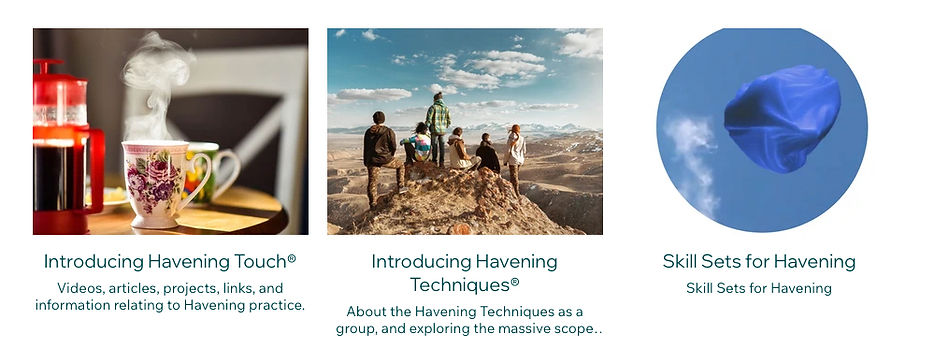
Join and log in to access. When you are studying with me, you can access this portal to find each section, including suggestions for a study plan, case study forms, projects, links, videos, and booklets about the Havening Techniques and Havening checklists and concepts. See images below to see the sections covered.
All Havening trainings start with reading the digital copy of the Primer in your Resource Library at www.havening.org. Click the images or button below to access an audio version of the Primer, illustrations and videos related to learning from the Primer.


The Havening Techniques®
Explorations, Projects, Food for Thought (downloadable booklets, links, videos, articles), and Case Examples to help you develop your skills. Havening in the Wild and more. Now you have read the Primer and watched videos of Havening sessions. You may have discovered that you have a few gaps in your knowledge base, and that's fine. There is so much to learn, and there is a lot of new information flowing through from neurobiologists which can inform our practice as Havening practitioners. The aim of the following sections, 'How we Learn', 'Introducing UTS and EMLI', 'Introducing CASE', 'Approaches to Sessions', 'Skills Sets for Havening', 'Havening Touch' and information about each of the Havening Techniques is to help you weave the biology basis into everyday practice and everyday life. For example, once you learn about the checklist CASE and start using it, and noting how useful it is, it becomes second nature to use it.